
Our History
Faith through the generations • Service through the years • Hope for the future
The Story of a Living Legacy
Faith through the generations • Service through the years • Hope for the future
A Journey Rooted in Faith, Sustained by Service
The story of the Church of South India Tiruchirappalli–Thanjavur Diocese is a story that reaches far beyond the formal establishment of the Diocese in 1947. It is a story woven through the lives of missionaries, pastors, teachers, physicians, evangelists, children, families and generations of faithful people who believed that the Gospel must not only be proclaimed, but also lived.
Long before the Diocese came into being, the soil of Tiruchirappalli, Thanjavur, the Cauvery delta, the western districts and the coastal regions had already been touched by a remarkable Christian missionary movement. Churches were planted, schools established, hospitals opened, communities nurtured and lives transformed.
The Diocese that emerged in 1947 therefore did not begin a new story. It gathered together, preserved and carried forward a legacy that had already been nurtured for generations.
The Beginning of a New Dawn
The Gospel reaches the shores of Tharangambadi
On the eastern coast of Tamil Nadu lies Tharangambadi, historically known as Tranquebar—a small coastal settlement whose place in the history of Christianity in India is immeasurable.
On 9 July 1706, the Lutheran missionaries Bartholomäus Ziegenbalg and Heinrich Plütschau arrived at Tharangambadi under the patronage of King Frederick IV of Denmark. Their arrival marked a significant moment in the history of Protestant Christianity in India.
Their ministry was characterised not merely by preaching, but by a deep engagement with language, education and the life of the people. The missionary movement that followed gradually extended beyond Tharangambadi into other parts of South India.
A succession of missionary societies subsequently contributed to the spread of the Gospel and to the emergence of educational, medical and social ministries in the region.
The seeds were being sown—not simply for churches, but for a Christian witness expressed through the transformation of human life.
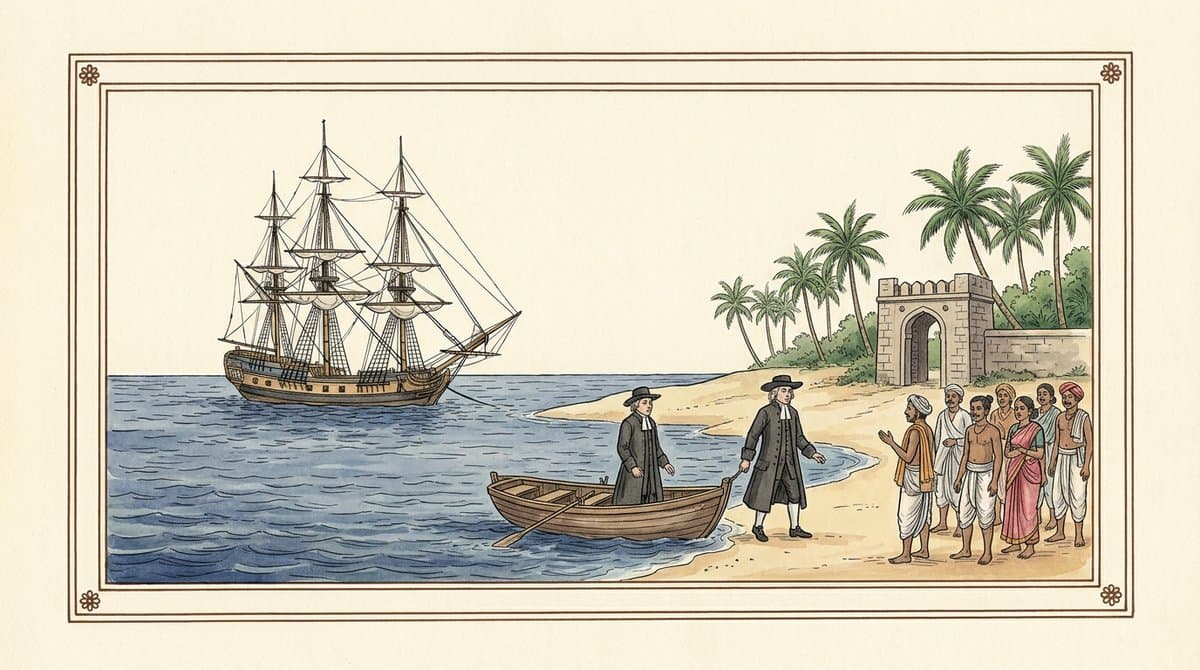
Illustration — a photograph will replace this
When Faith Took Root in Tiruchirappalli
The ministry of Christian Friedrich Schwartz
Among the towering figures in the early history of the region was Christian Friedrich Schwartz.
Born in Germany, Schwartz received his theological education at Halle and was prepared for missionary service. He arrived in India in 1750, landing at Cuddalore on 17 July and reaching Tharangambadi on 30 July. As he travelled and ministered, he became increasingly aware of the spiritual and educational needs of Tiruchirappalli.
His response was characteristic of the missionary spirit of the age: he came close to the people.
In 1762, a small prayer house was established in Tiruchirappalli, alongside a school. That early educational initiative would grow into institutions that remain deeply associated with the educational heritage of the Diocese.
The history preserved in the 75th Anniversary Souvenir also records Schwartz's response to the tragedy of the 1763 explosion of an arms depot in Tiruchirappalli, in which soldiers died and many children were left orphaned. He raised funds and established a school with hostel facilities for their care.
Thus, even in these earliest chapters, the character of Christian mission was becoming visible:
To proclaim Christ, to educate the young, to care for the vulnerable and to serve the community.
A Church, a School, a People
Christ Church and the growth of Christian witness
With the support of military and civil authorities, Schwartz was instrumental in the establishment of a church in Tiruchirappalli.
The foundation was laid in 1765, and on 18 May 1766, the church was consecrated on the Feast of Pentecost and named Christ Church.
Schwartz's ministry extended far beyond the pulpit. He was remembered as a preacher, educator, builder of churches and a compassionate servant of the people. He cared for wounded soldiers, established educational institutions and travelled widely to proclaim the Gospel.
He died in Thanjavur on 13 February 1798, leaving behind a legacy that continues to be remembered with gratitude.
His life offers one of the earliest defining images of the Diocese's heritage:
Faith that stepped beyond the sanctuary and into the life of the community.
The Legacy of Education
From a small school to a lasting educational tradition
Education became one of the most enduring expressions of Christian mission in the region.
The German missionary Rev. Christian Frederick Schwartz started two schools — one Tamil and the other English — in 1762. In 1825, the schools were vested in the Society for the Propagation of the Gospel and hence the name SPG School. The English School came under the care of Government Chaplain.That is the parent institution of the present St. John's Vestry Higher Secondary School, Tiruchy.
Rev. Reginald Heber, the then Bishop of Calcutta, during his visit in 1826 inspected the Fort School and expressed the wish that the school should grow into a college. Then, during his stay at Cantonment, he died unexpectedly and was buried with military honours at St. John’s Church, Tiruchy. Then, in 1864, the SPG School was moved to a more spacious Teppakulam campus with a new name, Heber Memorial High School. His wish came true after 47 years, and the SPG College came into existence. After a period of closure due to a financial crisis, it was revived in 1966 by our former Bishop, Most-Rev. Solomon Duraisamy. In 1926, at its Golden Jubilee Function, it was renamed Bishop Heber College.
Although institutional changes and the educational reorganisation of the period brought significant transitions, the educational ministry continued through schools and other institutions.
Today, education remains one of the defining ministries of the CSI Tiruchirappalli–Thanjavur Diocese. The Diocese's educational network includes 52 primary schools, 2 high schools, 17 higher secondary schools, 2 nursing schools, 2 Industrial Training Centres and four colleges in fields including Arts and Science, Management, Nursing and Community Welfare.
Yet the legacy is larger than numbers.
Education has always been understood as a ministry of transformation.
It seeks not merely to produce educated individuals, but to nurture character, responsibility, dignity, confidence and a commitment to serve society.
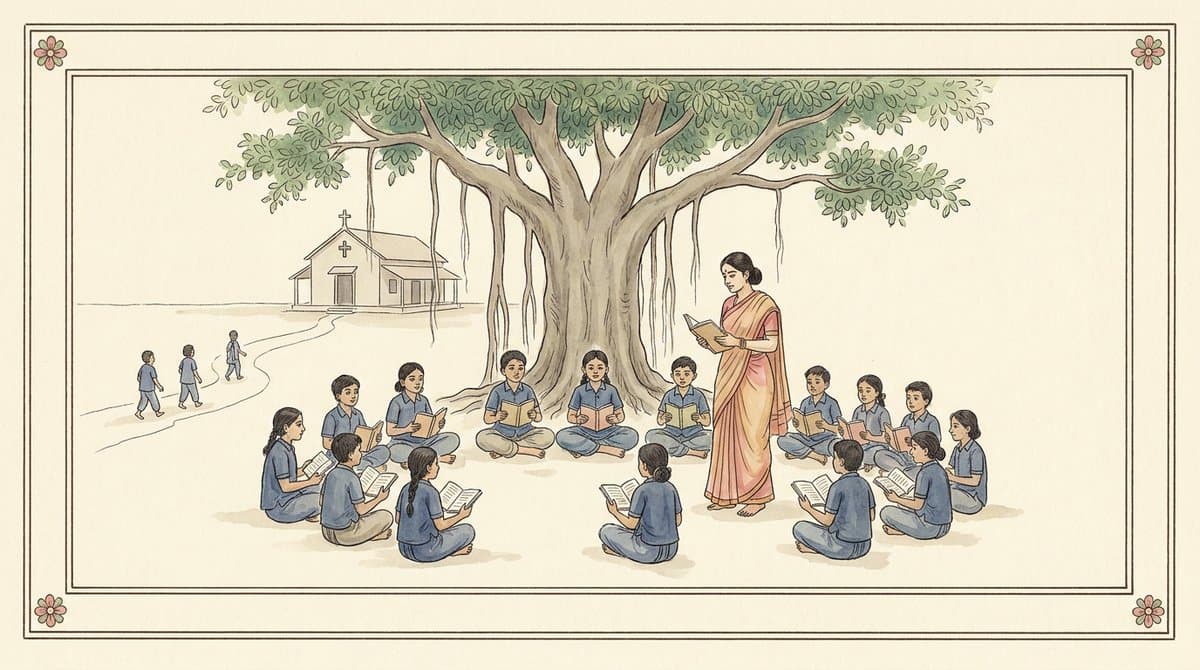
Illustration — a photograph will replace this
The Gospel Reaches the Villages
The Kollidam Mission
The missionary movement did not remain confined to towns.
In 1803, through the efforts of local converts and Christian workers, the Gospel reached a group of villages along the Kollidam River. The cluster of villages—including Irungalur and several neighbouring settlements—came to be associated with what became known as the Kollidam Mission.
The ministry of Christian Samuel Kohlhoff became particularly significant in this region. Although serving in the urban church, he chose to spend much of his ministry among village communities.
Land was secured for the mission. A residence was established. Schools were founded. Separate hostel facilities for boys and girls were developed.
The missionary work also addressed deeply rooted social practices. The historical account remembers efforts to challenge child marriage, superstition and social discrimination, while encouraging people to live with greater dignity and equality.
For 42 years, this ministry continued with remarkable dedication.
The Gospel travelled along the roads, into the villages and into the everyday lives of ordinary people.
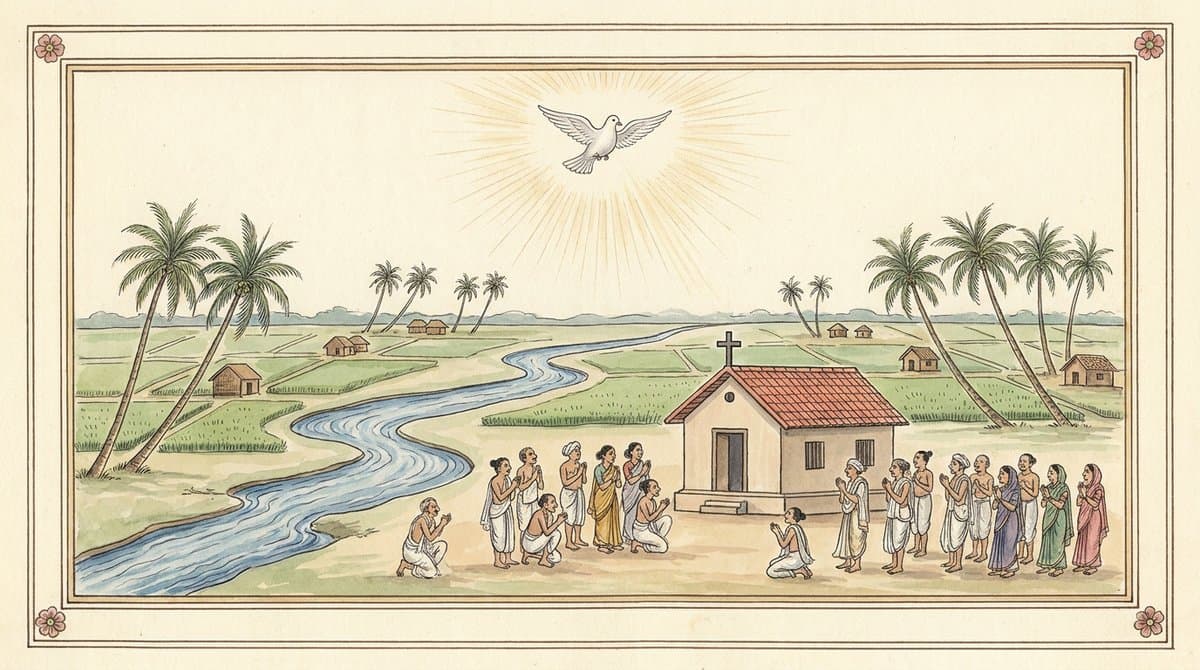
Illustration — a photograph will replace this
The Methodist Chapter
A new stream of missionary witness
The Methodist tradition also became an important part of the Christian heritage of the region.
The Methodist movement had emerged in Bristol in the eighteenth century, inspired by the missionary vision of John Wesley and his contemporaries. The Rev. Thomas Coke carried this missionary vision towards India and Ceylon.
The journey was marked by extraordinary hardship. In 1813, a group of Methodist missionaries sailed towards India and Ceylon. Their voyage was beset by storms, illness and tragedy, and Thomas Coke himself died during the journey.
Yet the mission continued.
On 28 January 1817, James Lynch and Thomas Squance arrived at Nagapattinam after travelling from Ceylon. Nagapattinam thus became one of the earliest places in India where Methodist preaching took place.
From Nagapattinam, the Methodist ministry gradually spread to other parts of the region.
When Education Became a Bridge
The Finlay educational legacy
The Methodist educational ministry expanded significantly in Nagapattinam.
In 1856, an English-medium school was established. In 1884, it was elevated to college status and became one of the earliest colleges established by the Methodist Church in India.
In 1898, the college was moved from Nagapattinam to Mannargudi, where it continued under the name associated with Findlay. From 1898 to 1934, it functioned as a prominent educational institution before being reorganised as a higher secondary school in 1935.
The story of Findlay is part of a larger truth:
Wherever the Church went, education travelled with it.
The Gospel and the Healing Ministry
Caring for body, mind and spirit
Christian witness in the region also found expression through healthcare.
Medical ministry in Tiruchirappalli began in the early twentieth century, with inpatient care developing by 1912. This ministry eventually became associated with the CSI Mission General Hospital, Uraiyur.
In the Dharapuram region, medical work also developed through missionary initiatives. Rural healthcare was taken directly to communities, and a hospital with inpatient facilities was established in 1933.
The present-day hospital ministry of the Diocese carries this tradition forward through institutions including the CSI Mission General Hospital, Uraiyur, Tiruchirappalli, and the CSI Dr. Anne Booth Mission Hospital, Dharapuram.
Healing has always been part of the Diocese's understanding of mission.
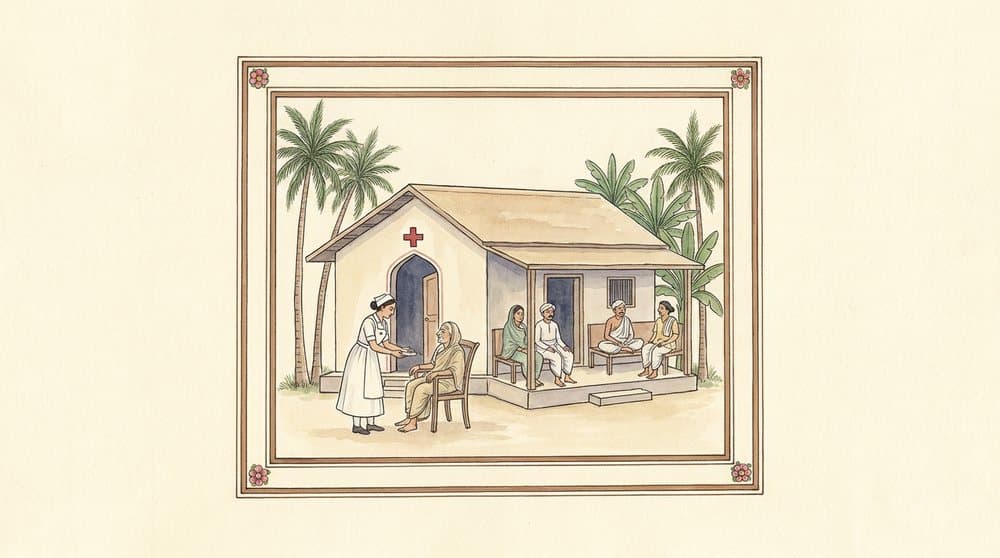
Illustration — a photograph will replace this
A People's Movement of Faith
The story of Abraham of Perungarunai Palayam
Among the most moving episodes preserved in the Diocese's history is the story of the Christian movement at Perungarunai Palayam, near Dharapuram.
An elderly man named Azhagan encountered Christian teaching through relationships formed in the course of his travels and gradually became deeply interested in the Christian faith.
He and his companions sought Christian instruction and eventually approached the Rev. Ellis, who was serving in the Dharapuram region.
The response was immediate. Ellis travelled by bicycle with a young colleague to the village, arriving late at night. The villagers gathered eagerly to listen.
But when the time came for baptism, opposition arose. Those who wished to become Christians faced the possibility of losing social relationships, access to water and employment, and acceptance within their community. One by one, those who had intended to receive baptism withdrew.
Azhagan alone remained.
On 22 February 1913, at the age of about fifty, he received baptism and was given the name Abraham, remembered in the tradition as the “father of the new believers.” Soon others followed, and within months the movement spread through the village. A small church was established at Perungarunai Palayam in 1914.
This was not merely the story of one conversion.
It became the beginning of a wider people's movement. New believers carried the message from village to village, and Christian communities emerged in places including Mettupalayam, Veerasolapuram, Senapathipalayam, Vellakovil, Udayur, Kottapalayam and other settlements.
When the Gospel Became Education
Rev. Ellis and the rural educational mission
The ministry that followed demonstrated an important principle: evangelisation and education could not be separated.
Between 1913 and 1920, the Rev. Ellis travelled extensively through the Dharapuram region, covering long distances to reach village communities.
He established day schools and night schools, convinced that education was essential if poor communities were to experience social and economic advancement.
Hostel-based education was also developed so that children from economically disadvantaged families could receive sustained schooling.
The movement reached the Anamalai region by 1918.
The classroom became another place of Christian witness.
From Many Traditions to One Church
The journey towards union
By the early twentieth century, different Protestant traditions were serving communities across South India.
Though these churches differed in their ecclesiastical traditions, a growing conviction emerged that Christians should seek greater unity.
In May 1919, representatives met at Zion Church, Tharangambadi, to explore the possibility of Church union. The meeting brought together representatives of the Anglican and South India United Church traditions. They prayed, fasted and sought a common basis for unity.
Their conclusions became known as the Tharangambadi Statement. It affirmed shared foundations including the Holy Scriptures, the historic creeds, the Sacraments of Baptism and Holy Communion, and the historic episcopal form of Church governance.
Further conversations followed.
In 1920, a Joint Committee was appointed to continue discussions on Church union. The Wesleyan Methodist tradition joined the negotiations in 1925, and a draft scheme of Church union emerged in 1929.
The road was not without difficulties. Questions concerning episcopal ministry and the nature of ordination required prolonged discussion.
Yet the vision of unity endured.
The Birth of a United Church
27 September 1947 — Dawn of new history
On 27 September 1947, the Church of South India was inaugurated.
Anglican, Methodist, Congregational and Presbyterian traditions came together in a historic union. The CSI Tiruchirappalli–Thanjavur Diocese was constituted as one of the first fourteen dioceses of the newly formed united Church.
The significance of that day lies not merely in an institutional merger.
It was a witness to the Christian conviction that unity is itself a form of testimony.
Different traditions, histories and ecclesiastical practices were brought together in a new expression of the Church.
From many traditions came one witness.
From many histories came one shared future.
The Diocese inherited the rich Anglican and Methodist missionary traditions that had already taken root across the region. Its formation was therefore both a new beginning and a continuation of a much older story.
Rt. Rev. Edgar Bentley Thorp
The First Bishop
The first Bishop of the newly formed Tiruchirappalli–Thanjavur Diocese was Rt. Rev. Edgar Bentley Thorp, who served from 1947 to 1962.
Born in Mysore in 1905, he was educated in India and later pursued higher studies in England, gaining distinction in both mathematics and theology.
His ministry brought together scholarship, pastoral commitment and a deep concern for education.
Before becoming Bishop, he served in educational and pastoral ministries, including the Finlay educational tradition and the Anamalai and Dharapuram areas.
As Bishop, he served the Diocese for fifteen years before retiring in 1962.
The first chapter of the Diocese was thus laid upon the foundations of faith, education, discipline and service.
Rt. Rev. Solomon Duraisamy
Building a Self-reliant Diocese
The second Bishop, Rt. Rev. Solomon Duraisamy, was consecrated on 8 February 1964 at St. Peter's Church, Thanjavur.
His episcopate was marked by organisational consolidation, financial strengthening and educational development.
The 75th Anniversary history records his efforts to lead the Diocese towards greater self-reliance, self-governance and capacity for mission. Income-generating properties were developed to strengthen the financial base and improve the welfare of Church workers.
His educational vision was particularly significant.
He worked towards strengthening education from the primary level through higher education and played an important role in reviving Bishop Heber College, which had remained closed for several decades.
His episcopate also saw the development of hostels, homes for children, facilities for senior citizens, institutions for persons with intellectual disabilities, women's hostels, rehabilitation initiatives and other welfare institutions.
From 1974 to 1980, he served as Deputy Moderator of the Church of South India and from 1980 to 1982 as Moderator.
After eighteen years of episcopal ministry, he retired in June 1982.
A ministry of building—institutions, resources and people.
Rt. Rev. Dr. R. Paulraj
Education and Expansion
The third Bishop, Rt. Rev. Dr. R. Paulraj, was consecrated in 1982.
A son of a family deeply connected with Christian service, he brought to the episcopate a strong commitment to prayer, evangelisation and theological education.
His sixteen-year episcopate witnessed significant institutional development. The second development phases of Bishop Heber College and the Mission General Hospital were completed. Bishop Thorp College, Dharapuram, was established in 1984, followed by Bishop Nursing College, Dharapuram, in 1993.
His ministry reflected a conviction that the Church must continually equip itself to respond to changing educational and social needs.
Faith was being translated into institutions that could serve generations yet unborn.
Rt. Rev. Dr. James Srinivasan
A Vision for a Self-reliant Church
The fourth Bishop, Rt. Rev. Dr. James Srinivasan, was consecrated on 5 July 1998.
His episcopal ministry placed particular emphasis on:
transparent and responsible administration;
financial self-reliance;
strengthening democratic participation in congregational life;
improved welfare and remuneration for Church workers;
retirement and pension initiatives;
structured training for ministry; and
long-term financial planning.
One of the significant initiatives of the period was the establishment of a long-term reserve fund, intended to generate resources for ministry in the future.
His tenure also strengthened international partnerships, including the Diocese's relationship with Leicester in the United Kingdom.
The Diocese entered the new millennium with an increasingly strengthened institutional foundation.
A Church rooted in its past, yet preparing deliberately for its future.
Rt. Rev. Dr. G. Paul Vasanthakumar
Renewing the Life of the Church
The fifth Bishop, Rt. Rev. Dr. G. Paul Vasanthakumar, assumed episcopal ministry in 2008.
His episcopate placed particular emphasis on revitalising rural congregations and strengthening the mission of the Church among village communities.
Churches, schools and other institutions in rural areas were renovated and new ministry centres were developed. Environmental initiatives were also undertaken, including land restoration and tree-planting efforts.
His period also witnessed significant educational and institutional milestones, including the continued development of Bishop Heber College and the strengthening of relationships with churches and Christian organisations beyond India.
The Diocese celebrated important anniversaries during this period, including its 70th anniversary, while Bishop Heber College achieved national recognition in higher education.
Renewal was understood not simply as growth, but as a return to the Church's calling to serve people faithfully.
He completed his episcopal ministry in April 2018.
Rt. Rev. Dr. T. Chandrasekaran
Solidarity in Times of Crisis
The sixth Bishop, Rt. Rev. Dr. T. Chandrasekaran, was consecrated on 28 May 2018 at St. Luke’s Church, Bishop Heber College.
His episcopate has emphasised solidarity and service, with attention to evangelisation, rural mission, healthcare, education, children's welfare and institutional development.
During Cyclone Gaja in 2018, the Diocese supported the restoration of affected churches and communities. During the COVID-19 pandemic in 2020, it sustained worship through digital platforms and mobilised food and relief materials for thousands of families without discrimination. From 2019 onwards, thanksgiving offerings were channelled towards the restoration of rural churches and schools, turning gratitude into tangible service.
Its institutions continued to serve as important spaces for education, care and social engagement, while the Church sought to deepen its presence among people through pastoral outreach and community-based initiatives. Together, these efforts reflected an understanding of Christian ministry as both proclamation and service—where faith finds expression in compassion, inclusion and responsibility towards society.
Rt. Rev. Dr. S. Samuel Rajadurai
Balancing Scripture and Constitution for the Development of Faith and Distribution of Justice
The seventh Bishop of the Tiruchirappalli–Thanjavur Diocese, Rt. Rev. Dr. S. Samuel Rajadurai was consecrated on 6 December 2025 at St. Luke’s Church, Tiruchirappalli.
His episcopate affirms three major things:
Revival of Christian faith and works rooted in faith.
In managing the providence for the people, to do mercy and justice to the marginalised.
To conduct the financial affairs of God’s household with integrity and faithfulness.
Though the challenges are many, the Diocese continues its journey of faith by the grace and providence of our faithful Saviour, Jesus Christ!
Mission Beyond Borders
Evangelisation, partnership and shared ministry
Mission and evangelisation remain central to the identity of the Diocese.
The Diocese has continued to strengthen mission through ministry centres, rural congregations and missionary workers. Its partnership with the other missionary movements like IMS, VISHWAVANI, IFM has enabled additional Hindi speaking workers to serve across different mission fields and new congregations.
At the same time, the Diocese has cultivated relationships with churches and Christian organisations in other countries, including Leicester, Scotland, Korea, Africa and other international partners.
These relationships reflect an understanding that the Church is part of a global body of Christ, called to share resources, learning, prayer and mission across geographical boundaries.
A Ministry of Healing
Healthcare as Christian compassion in action
The healthcare ministry of the Diocese continues the tradition of compassion established by earlier generations.
The CSI Dr. Anne Booth Mission Hospital, Dharapuram, has been strengthened with experienced medical professionals, Doctors with specialised medical knowledge for vital organs, modernised equipments and compassionate services have made CSI Mission General Hospital, Tiruchirappalli and CSI Dr. Anne Booth Mission Hospital Dharapuram attract people who suffer. CSI Mission General Hospital, Tiruchirappalli, has continued to develop its medical facilities and diagnostic services. The Diocese's nursing education also contributes to this healing ministry through professional preparation of nurses and healthcare personnel.
To heal is to serve.
To serve is to embody Christ's compassion.
Caring for Children
A ministry of protection, nurture and hope
The Diocese has historically cared for children through schools, hostels, residential institutions and welfare initiatives.
As international support for some children's homes diminished, the Diocese responded by establishing a Diocesan Fostership Scheme, ensuring that children's education and wellbeing would not be abandoned.
The initiative mobilises support across the Diocese and creates a sustained fund for children's welfare.
This reflects a central conviction of the Diocese:
Every child deserves the opportunity to learn, to grow in safety, to experience dignity and to hope for a meaningful future.
From Three Districts to a Wider Fellowship
A growing Diocese
At the time of the formation of the Church of South India, the Tiruchirappalli–Thanjavur Diocese had a much smaller administrative structure.
Over the decades, the Diocese expanded its ministry across a broad geographical region encompassing Tiruchirappalli, Thanjavur, Tiruvarur, Nagapattinam and Mayiladuthurai, together with portions of Karur, Perambalur, Ariyalur, Pudukkottai, Cuddalore, Tiruppur and Coimbatore, and parts of the Union Territory of Puducherry, including Karaikal.
Now, the Diocese is organised into eight District Church Councils:
- Thanjavur
- Tiruchirappalli
- Perambalur
- Karur
- Dharapuram
- Udumalaipettai
- Tharangambadi–Nagapattinam
- Anaimalai Hills
What began as a small ecclesiastical unit has grown into a broad fellowship of congregations and ministries spread across urban, rural and tribal contexts.
The Journey Continues
From Mission to Ministry.
From Education to Empowerment. From Compassion to Transformation. From Legacy to Living Faith.
The journey that began on the shores of Tharangambadi in the eighteenth century did not end with the formation of the Diocese in 1947.
It continues.
It continues wherever a child is taught.
Wherever a patient is cared for.
Wherever a village church gathers in prayer.
Wherever a young person discovers hope.
Wherever the vulnerable are embraced with dignity.
Wherever the Church stands beside people in their hour of need.
The CSI Tiruchirappalli–Thanjavur Diocese therefore looks back not merely with nostalgia, but with thanksgiving.
It remembers the pioneers with gratitude, receives the present with responsibility and looks towards the future with faith.
For the story of the Diocese is ultimately not only about what earlier generations built.
It is about what each generation is called to build upon that foundation.
The words of Scripture continue to resonate with this living heritage:
“Thus far the Lord has helped us.” — 1 Samuel 7:12
See it all on one line
Every dated milestone in this history, spaced by the years between them.